Motivation Comes and Goes. What Helps Us Keep Going?
Reflections on motivation, discipline and a special professional milestone.
There are moments in our professional lives that invite us to pause, reflect and appreciate how far we've come.
Recently, I experienced one of those moments.
I'm delighted to share that an article I wrote about motivation versus discipline has been published in the official magazine of the National Hypnotherapy Society.
As a hypnotherapist, having the opportunity to contribute to a professional publication means a great deal to me. It's especially meaningful because the topic brings together two areas that have shaped my understanding of personal growth: endurance sports and therapeutic work.
At the heart of the article is a question I often return to:
What helps us keep going when motivation is no longer there?
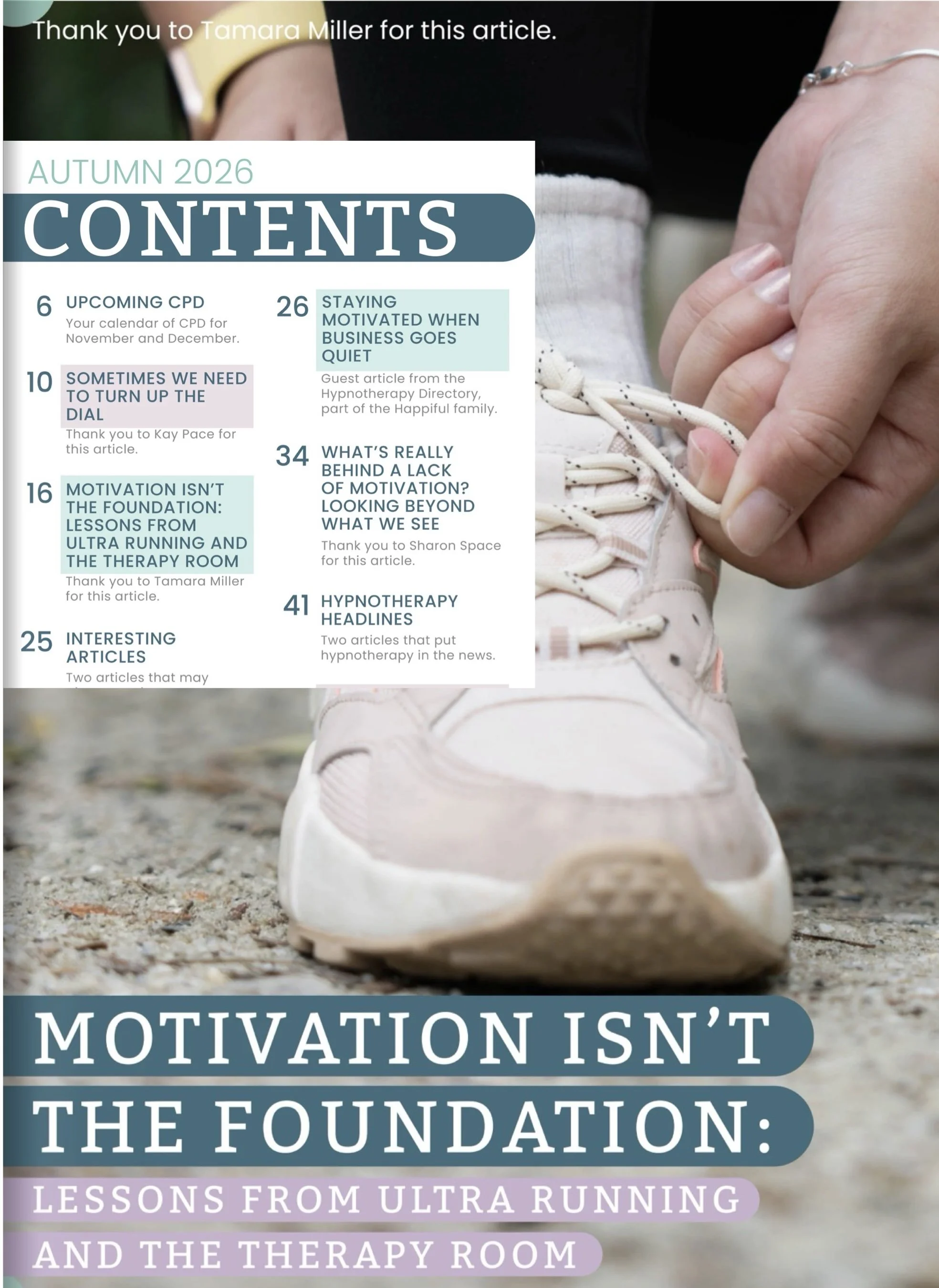
Motivation Is Wonderful. But It Isn't Always Reliable.
Most of us know the feeling of being motivated.
That sudden excitement about starting something new. The determination to establish a healthier routine, overcome an unhelpful habit, prepare for a challenge or make a meaningful change in our lives.
Motivation can be a powerful starting point.
But motivation is also a feeling, and feelings naturally fluctuate.
Some days we feel energised, focused and ready to take action. Other days, the same task can feel surprisingly difficult.
Perhaps we're tired. Perhaps life has become overwhelming. Perhaps the initial excitement has simply worn off.
And that's perfectly human.
The difficulty arises when we believe we need to feel motivated before we can take the next step.
Because if we wait for motivation to return every time, we may find ourselves waiting much longer than we'd like.
What Endurance Sports Have Taught Me About Discipline
Through my own experiences with ultrarunning and Ironman events, I've learned that motivation alone doesn't carry us through every training session.
There are days when training feels enjoyable and energising.
And there are days when it doesn't.
What has helped me is learning to look beyond how I feel in a particular moment and reconnect with the bigger picture.
Why does this matter to me?
What am I working towards?
And what small action would support that today?
Sometimes that action is training.
Sometimes it's adjusting the plan.
And sometimes it's recognising that rest is the most appropriate choice.
This is an important distinction.
Discipline doesn't have to mean being rigid, ignoring our needs or pushing ourselves regardless of the circumstances.
It can mean developing a consistent, compassionate relationship with our commitments.
One that allows for flexibility, recovery and changing circumstances.
For me, sustainable discipline is less about forcing ourselves to do more and more about learning to work with ourselves.
How This Connects With Hypnotherapy
This understanding also influences my work at Rooted Calm.
People often seek hypnotherapy because they would like something in their lives to change.
Perhaps they want to feel calmer in certain situations, develop greater confidence, create healthier habits or respond differently to an established pattern.
Often, the desire for change is already there.
But wanting something to change and knowing how to move towards it can be two very different experiences.
We may consciously understand what we'd like to do differently, yet find ourselves returning to familiar responses.
And that's where it can be helpful to explore more than motivation alone.
In hypnotherapy, we can work with guided relaxation, visualisation, therapeutic suggestions and practical techniques to help someone rehearse and develop alternative ways of responding.
For example, we might explore how someone would like to feel in a particular situation, imagine responding with greater calm or confidence, and develop a simple anchor they can practise in everyday life.
Rather than waiting until they feel completely ready, they can begin taking small, manageable steps towards the change they'd like to experience.
Hypnotherapy isn't about taking away someone's control or doing the work for them.
It's a collaborative process that can support reflection, practice and personal change.
Perhaps We Don't Need More Motivation
One of the ideas I find particularly valuable is that we don't always have to wait until we feel different before we begin doing something differently.
Sometimes, a small action can come first.
Perhaps it's taking a short walk when we've been feeling stuck.
Practising a calming technique before a difficult conversation.
Returning to a helpful routine after a break.
Or simply making one small decision that moves us towards something important.
Those actions don't need to be dramatic.
In fact, meaningful change often begins quietly.
And when we repeat supportive actions over time, they may gradually become more familiar and easier to return to.
There's a phrase I often come back to:
Mood follows action.
Not always, of course. Our emotions are complex, and we cannot expect every action to change how we feel.
But sometimes taking a small, thoughtful step can help us shift from waiting for the right feeling towards actively supporting ourselves.
Discipline Can Be an Act of Self-Compassion
We sometimes associate discipline with strict routines, pressure and self-criticism.
But I believe it can also be something much gentler.
Discipline can mean choosing to care for ourselves consistently.
Keeping a promise to ourselves without demanding perfection.
Making space for what supports our wellbeing.
Being willing to start again when life interrupts our plans.
And perhaps most importantly, recognising that progress doesn't have to look the same every day.
There will be days when we have more capacity.
And days when we have less.
Neither defines our worth or our ability to grow.
The aim isn't to become someone who never struggles with motivation.
It's to develop an approach that can support us even when motivation fluctuates.
A Moment of Gratitude
Seeing my article published in the National Hypnotherapy Society magazine is a milestone I'm very grateful for.
Writing gives me an opportunity to reflect on the connections between lived experience, therapeutic practice and the many different ways we navigate change.
I'm grateful to have been able to contribute to a conversation that I believe matters both inside and outside the therapy room.
And if there's one thought I'd love readers to take away, it's this:
You don't have to feel motivated every day to make meaningful progress.
Sometimes, the smallest, most compassionate actions are the ones that help us move forward.
And sometimes, learning to begin again is an important part of the process.
Exploring Change Through Hypnotherapy
If you're feeling stuck in an unhelpful pattern, finding it difficult to maintain positive habits, or would simply like to explore a different way of responding to life's challenges, hypnotherapy may be one way to support that process.
At Rooted Calm Hypnotherapy, I offer personalised, mindful and forward-focused hypnotherapy online and in person in Parkstone, Poole.
Every journey begins with a free, no-obligation 15-minute consultation, where we can talk about what you'd like support with and whether hypnotherapy feels right for you.